Singular they has become the pronoun of choice to replace he and she in cases where the gender of the antecedent – the word the pronoun refers to – is unknown, irrelevant, or nonbinary, or where gender needs to be concealed. It’s the word we use for sentences like Everyone loves his mother.
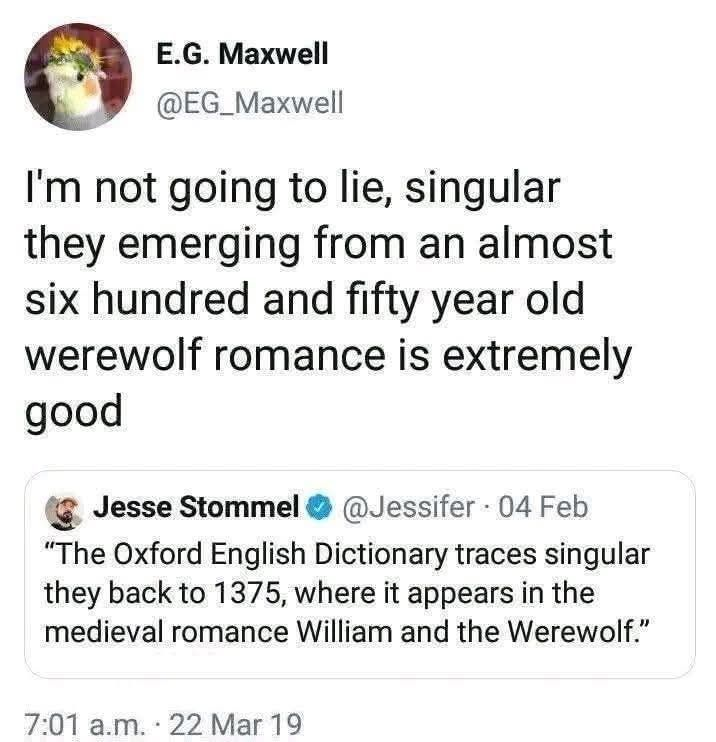
But that’s nothing new. The Oxford English Dictionary traces singular they back to 1375, where it appears in the medieval romance William and the Werewolf. Except for the old-style language of that poem, its use of singular they to refer to an unnamed person seems very modern. Here’s the Middle English version: ‘Hastely hiȝed eche . . . þei neyȝþed so neiȝh . . . þere william & his worþi lef were liand i-fere.’ In modern English, that’s: ‘Each man hurried . . . till they drew near . . . where William and his darling were lying together.’
Since forms may exist in speech long before they’re written down, it’s likely that singular they was common even before the late fourteenth century. That makes an old form even older. {read}
Plot of the Poem
The romance opens (and returns later) in the Kingdom of Sicily and Apulia. The author displays considerable intimacy with the geography of this Norman kingdom.[31][32]
King Embron and his queen Felise have a baby son, who is kidnapped and raised by a kindly wolf who knew the king’s brother was aiming to kill the child.[33] The wolf was in truth a prince of Spain, transformed by an evil stepmother.[34] The child is discovered one day and adopted by a cowherd as his son “Guillaume”.[35][33] He is of great prowess and draws the notice of the emperor of Rome, who brings Guillaume to court as the valet to his daughter Melior. They fall in love with each other,[36] but she struggles with the unknown origins of her valet.[37][38] And then, his prowess becomes even more renowned after Guillaume is instrumental in defeating the Saxons.[39]
Though Melior’s love grows stronger, a contingent of the Greek Emperor arrives with the Greek prince’s proposal of marriage to the Roman princess. The Roman Emperor Nathaniel gives immediate consent. The lovers flee into the woods disguised in bear-skins. The same Spanish prince turned wolf (Guillaume’s cousin Alphonse[9]) appears to the fugitive couple, providing them with food and drink stolen from the clerics and peasants.[40] The marriage ceremony had been prepared in Rome, but the bride’s disappearance angers the Emperor who orders a search in the woods. The wolf holds the soldiers at bay, but witnesses come forward having seen the bears leave town. The theft of the bearskins is discovered, and the ruse unravels. The wolf now takes the lovers on a journey towards Apulia, but along the way at Benevento (Bénévent) they are discovered by miners while taking shelter inside what they mistakenly thought was an abandoned mine or quarry. A posse arrives to capture them, but the wolf diverts attention by carrying off the magistrate’s child, and they escape. The wolf has the couple wear deerskin as disguise.[41]
The group reaches war-torn Apulia, where Guillaume’s sister Florence remains. The invading Spanish king was scheming to marry his witch-wife’s son Brandin to Florence.[42] The group cross the Strait of Messina and arrive in Palermo (then capital of the Norman Kingdom of Apulia and Sicily[43]). The city is at war, defended by King Embron’s widow (Guillaume’s mother) against the military invasion by the King of Spain (Alphonse’s father). When Guillaume arrives in the guise of a deer, the Queen realizes this must be the deliverer of their sorrows, but she and her son do not recognize each other,[b] as Guillaume has never known his origin. Guillaume accepts aiding the defense and asks for armament. Then the king’s warhorse Brunsaudebruel[c][d], which never let any man beside its master ride it, is brought to Guillaume and now recognizes him.[49] The benevolent werewolf is disenchanted and marries Guillaume’s sister.[9]